 English
 Español
 Русский
 Árabe
 简体中文
 ไทย
 Français
 Deutsch
 Português
 日本語
 한국어
 हिंदी
 Prancis
 Türkçe
 Tiếng Việt
 Italiano


Reflective Aluminum Foil Thermal Insulation
Double Bubble & EPE Foam Foil Reflective Thermal Insulation Roll
Structure; Aluminum Foil+Bubble+EPE Foam + Bubble+Aluminum Foil
Thickness; 10mm or customized
Size; 1.2*20m per roll or customized
Reflectivity ; 97%
MAX R Value;
Heat Flow Down (Roof);14.8m²*k/w
Heat Flow Horizonta (Wall);7.8m²*k/w
Heat Flow Up (Floor);4.9m²*k/w
This reflective Thermal insulation combining aluminum foil, double bubble layers and EPE foam core. Designed to reduce radiant heat and heat transfer while providing moisture resistance for roofs, walls and floors in metal & steel buildings, timber buildings,warehouses, factories and other commercial construction projects.
Product Details
Description
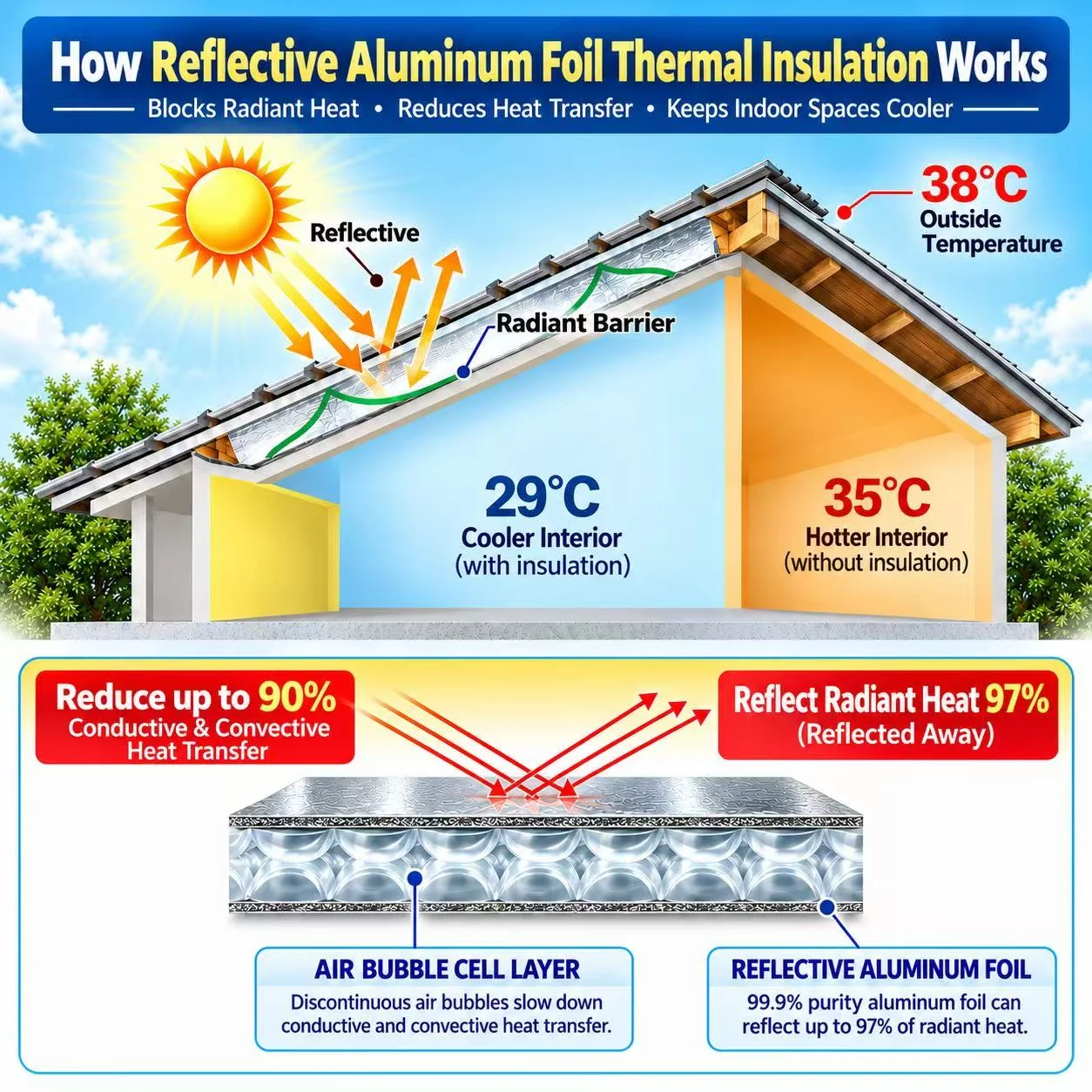
Aluminum Foil Bubble & EPE Foam Reflective Thermal Insulation Roll is a multi-layer reflective thermal insulation material featuring aluminum foil, double bubble layers and an EPE foam core. The reflective foil surface can reflect up to 97% of radiant heat, while the bubble and foam structure helps reduce heat transfer through conduction and convection.
Designed for roof, wall and floor insulation, it is widely used in metal and steel buildings, timber buildings,warehouses, factories, workshops, prefabricated houses and commercial construction. Available in customized widths, lengths, thicknesses, surface materials, printing and packaging for OEM and ODM projects.


Key Product Features
1. Up to 97% Radiant Heat Reflectivity:
Double-sided pure aluminum foil can reflect up to 97% of radiant heat, helping reduce heat gain and heat loss in building applications. Metallized foil surface options are also available.
2. Multi-Layer Thermal Insulation Structure:
The aluminum foil, bubble and EPE foam structure combines reflective insulation with resistance to conductive and convective heat transfer. In roof applications, the installed system R-value can reach up to R-14.8 with a 10 mm product, depending on the building structure and installation method.
3. Thermal, Moisture & Radiant Heat Protection:
Provides thermal insulation, radiant heat protection, energy-saving performance and moisture resistance in one material. Fire-retardant grades are available, while the bubble and foam core can also help reduce noise transmission.
4. Versatile Building Applications:
Suitable for roof, wall and floor insulation in metal buildings, steel structures, warehouses, factories, workshops, timber buildings, prefabricated houses, offices, hotels and other commercial construction projects.
5. Lightweight & Easy to Install:
The lightweight and flexible insulation roll is easy to cut, join, tape and mechanically fix using common installation tools. No specialized equipment is required for most applications.
6. OEM & ODM Customization:
Custom widths, lengths, thicknesses, surface materials, printing, packaging and labels are available. OEM and ODM production can be developed according to project requirements, drawings or approved samples.

Product Specifications
| Thickness | Tensile Strength | Tear Strength | Length | Width | Sqms/Roll | |||||
| 10mm(15mm is also ok) | 14.61B/Inch | 4.51B/Inch | 20m | 1.2m | 24m² | |||||
| Max R Value | ||||||||||
| Heat Flow Down(Roof) | Heat Flow Horizonta(Wall) | Heat Flow Up(Foor) | ||||||||
| 14.8m²*k/w | 7.8m²*k/w | 4.9m*k/w | ||||||||
| Reflectivity | Emissivity | Water proof | Fire proof | Temperature | ||||||
| 97% | 0.03 | 100% | CLASS A | -50℃ TO 80℃ | ||||||
| Product Width (in.) | customized | Type | bubble foil insulation |
| Application | roof, wall, floor, Warehouse, shed, factory,metal building, steel building, timber building, commercial building | Product Length (ft.) | customized |
| Insulation Features | Fire retardant Pure AL | Shape | roll |
| Eco Friendly | Yes | Warranty | 1Year |
| After-sale Service | Online Technical Support | Project Solution Capability | 3D model design,total solution for projects |
| Length | Customized | Design Style | Modern |
| Model Number | AL+Bubble+EPE foam+Bubble+AL | Place of Origin | QingDao,China |
| Brand Name | TaiYue | Width | 1.2m or Customized |
| Length | Customized | Thickness | 10mm or Customized |
| Aluminum FoilType | Pure AL/Metalized AL | Colorful(Anti-glare function) | Aluminum/Foam |
| Package/Label Design | Can be Customized | Backing Adhesive | Can be Customized |
| Function | therma insulation,radiant heat protection,energy saving,vapor barrier | Reflectivity | 95-97% |
| Certificate | CE,ISO9001 | ||
Manufacturer Support
TaiYue has specialized in aluminum foil thermal insulation manufacturing since 2002. With 10+ production lines, we supply more than 400 containers annually to customers in 100+ countries and regions. Factory-direct production supports stable supply, OEM/ODM customization and consistent quality for distributors, importers and project buyers.
Lead Time
Standard production lead time is typically 20–30 working days, depending on order quantity, specifications and customization requirements. Priority production can be discussed for urgent orders.
Sample Support
Free material samples are available for quality and specification evaluation. Courier costs are paid by the buyer. Mass production is controlled according to the confirmed specifications and approved sample.


FAQ
1.What are the main function of your “Aluminum Foil Insulation”?
Its main functions include thermal insulation, radiant heat protection, energy saving, and moisture resistance.They can provide a temperature difference of 3-9°C for you.
2.What are the main application of your “Aluminum Foil Insulation”?
They are mainly Designed for roof, wall and floor insulation, widely used in metal and steel buildings, timber & wooden buildings,warehouses, factories, workshops, prefabricated houses and other commercial construction projects.
3.What is the working principle of your “Reflective Aluminum Foil Thermal Insulation Material”?
There are three modes of heat transfer: Radiation, Conduction and Convection.
The aluminum foil on the surface of our insulation materials reflect radiation, and the bubble or foam in the middle slows down heat conduction and heat convection, achieving excellent thermal insulation performance.
It is one of the most advanced and widely popular building insulation materials on the market today.
4 .What is the difference between “pure aluminum foil”, “metallized aluminum foil” and “white film” surfaces? And what is the reflectivity of each material?
We usually use pure aluminum foil, which has 97% reflectivity, fire retardant and long service life for better performance. We highly recommend our customers choose it.
Meanwhile, we can also use metalized aluminum foil , which has 90% reflectivity.Its performance is not as good as pure aluminum foil, and it is not fire retardant, but it is more affordable.
White film is a PE film. It does not have the reflective properties. Its mainly used to protect the insulation core,provide a clean and attractive appearance.
5. Can you provide full customization and OEM & ODM services?
Yes, we offer comprehensive customization services, including product sizes, thickness, surface materials, colors, printing, packaging, labels, and more. We will work closely with you to develop a solution that meets your specific requirements and helps you achieve your goals.And OEM & ODM services are available.
6. How do I choose the right structure and thickness?How can I get a quotation? Can I get samples?
Please consult our sales team. Based on your requirements and local market preferences, we will recommend the most suitable product structure and thickness for you.Then We will provide you with an accurate quotation based on your required quantity, any specific requirements you may have, and the associated local charges.
And we would be happy to send you samples for your reference. We promise the quality of mass production will be exactly the same as sample.
7.Are you a factory or trading company?
We are a professional manufacturer established in 2002. Our factory is located in Qingdao, Shandong Province. With decades of mature production experience, we deliver reliable quality and competitive factory-direct prices.
8.What is your production lead time?What is your payment terms?
The production lead time depends on structure and quantity, usually 15-25 working days after we receiving the deposit.
And the payment terms we generally accept are : 30% of total amount as deposit, and 70% balance before shipment.
Detailed Product Information:
Aluminum Foil Bubble & EPE Foam Reflective Thermal Insulation Roll
1. Overview of Five-Layer Reflective Bubble Foam Insulation
Aluminum Foil Bubble & EPE Foam Reflective Thermal Insulation is a multi-layer insulation roll developed for building applications where both radiant heat reflection and resistance to heat transfer are important.
Unlike conventional foil-faced bubble insulation, this construction combines two bubble layers with an additional Expanded Polyethylene (EPE) foam core. The resulting five-layer material brings together reflective aluminum foil surfaces, enclosed air bubbles and a flexible foam insulation layer in one composite roll.
The product is commonly considered for roof, wall and selected floor insulation applications in metal buildings, steel structures, warehouses, industrial facilities and prefabricated construction.
For building material importers and insulation distributors, the structure provides an alternative to standard single or double bubble foil products, particularly when a thicker composite insulation material is preferred.
TaiYue manufactures this reflective insulation in roll form, with different thicknesses, dimensions, foil facings and packaging options available according to confirmed order requirements.
2. Understanding the Five-Layer Material Construction
The product uses the following composite structure:
Aluminum Foil + Bubble + EPE Foam + Bubble + Aluminum Foil
Each component performs a different function within the insulation system.
Reflective Aluminum Foil Facings
The outer aluminum foil surfaces are designed to reduce radiant heat exchange when installed facing an appropriate air space. Pure aluminum foil can reflect up to 97% of radiant heat under suitable conditions.
The two-sided reflective construction allows the product to be considered for different installation arrangements, although the actual benefit of each surface depends on the surrounding assembly.
Double Bubble Insulation Layers
Two layers of enclosed air bubbles form part of the insulation core. The trapped air helps limit heat conduction through the material and restricts air movement within individual bubbles.
These bubble layers also contribute flexibility and cushioning, allowing the composite material to be supplied as rolls rather than rigid boards.
Central EPE Foam Insulation Layer
Expanded Polyethylene foam forms the middle layer of the product. Its lightweight cellular structure provides additional resistance to conductive heat flow while maintaining the flexibility needed for handling and installation.
The EPE core separates the two bubble layers and increases the overall composite thickness.
Together, the five layers create a reflective insulation material that combines low-emissivity surfaces with internal insulating components.
3. How Bubble and EPE Foam Work Together to Reduce Heat Transfer
Building heat transfer involves three main mechanisms: radiation, conduction and convection.
Understanding these mechanisms is useful when comparing reflective foil insulation with conventional bulk insulation materials.
Reducing Radiant Heat Transfer
Radiant heat travels through electromagnetic radiation. In metal-roof buildings, heated roofing materials can transfer radiant energy toward cooler surfaces beneath them.
A clean, low-emissivity aluminum foil surface facing an air space reduces radiant heat exchange across that space. This is one of the main reasons reflective foil insulation is used in roof applications.
Slowing Conductive Heat Flow
Conduction occurs when heat moves through materials because of a temperature difference.
The EPE foam core and bubble layers provide resistance to this process. Their cellular structures contain air, which has relatively low thermal conductivity when movement is restricted.
Adding a foam core does not automatically guarantee a particular thermal resistance value, but it changes the composition and thickness of the insulation compared with a bubble-only structure.
Restricting Internal Air Movement
Convection involves heat transfer through moving fluids, including air.
Inside the enclosed bubble and foam cells, air movement is restricted. This contributes to the insulating function of the internal layers.
However, the insulation does not eliminate air movement within an entire roof or wall assembly. Unsealed openings, ventilation cavities and installation gaps must still be considered during building design.
The combination of these functions makes aluminum foil bubble EPE foam insulation a practical material option for applications requiring both reflective and foam-based thermal protection.
4. Why Air Space Matters in Reflective Insulation Systems
One of the most important considerations when using aluminum foil reflective thermal insulation is the presence and arrangement of adjacent air spaces.
A reflective aluminum surface works by limiting radiant heat exchange with another surface across an air gap.
If the foil is pressed directly against another solid material, the radiant barrier effect at that interface is substantially reduced because there is no intervening air space for radiant exchange.
For this reason, the same reflective insulation roll may perform differently depending on whether it is installed beneath metal roofing, within a framed wall cavity or between other construction components.
Important installation variables include:
The depth and location of the adjacent air cavity.
Whether the reflective surface faces the cavity.
The direction of heat flow.
The orientation and condition of the foil surface.
The presence of ventilation, joints and thermal bridges.
The enclosed bubbles and EPE foam continue to provide material insulation functions, but the performance of the reflective surfaces should be evaluated as part of the complete construction.
This distinction is particularly important for contractors and wholesale buyers comparing different radiant barrier insulation products.
5. R-Value: Why Roof, Wall and Floor Performance Can Differ
R-value is used to describe resistance to heat flow. However, the R-value of an insulation material should not be confused with the thermal resistance of a complete building assembly.
For a multi-layer reflective insulation system, the surrounding air spaces and installation method may contribute significantly to the reported system performance.
Three heat-flow directions are commonly considered:
Downward Heat Flow – Roof Applications
Downward heat flow is relevant to certain roof conditions, including solar-heated roofing assemblies. The thermal resistance associated with air spaces can differ from that of other orientations.
Horizontal Heat Flow – Wall Applications
In wall assemblies, heat commonly travels horizontally through the construction. Wall framing, air cavities and other materials influence the overall result.
Upward Heat Flow – Floor Applications
Upward heat flow requires a different thermal evaluation, as the behavior of adjacent air spaces changes with orientation.
When comparing published insulation specifications, buyers should confirm whether the stated value refers to the material alone or a tested installation system.
For projects with mandatory energy-efficiency standards, the relevant thermal performance documentation and proposed construction details should be reviewed before product selection.
6. Applications in Metal Roofing and Industrial Buildings
Metal roofing is widely used in factories, warehouses, workshops, agricultural sheds and industrial structures because of its practical construction characteristics.
However, exposed metal roofs can become hot under direct sunlight, contributing to heat gain inside the building.
Reflective insulation may be incorporated beneath suitable roofing assemblies to help reduce radiant heat transfer and provide additional resistance to heat flow.
The Bubble & EPE Foam composite structure is an option for projects where the buyer requires a flexible insulation roll with both reflective surfaces and internal foam insulation.
Typical project considerations include the roofing profile, available cavity space, support framing, fixing arrangement and moisture management.
The insulation should be selected according to the actual roofing system rather than assuming that the same installation method is suitable for every metal building.
For projects that require a different thickness or simpler internal construction, Double Bubble Foil Insulation may also be considered.
7. Wall Insulation for Steel, Timber and Prefabricated Construction
This five-layer reflective insulation roll can also be considered for selected wall assemblies in metal and steel buildings, timber structures and prefabricated construction.
Wall insulation requirements differ from those of roofs because framing systems, cavity depths, moisture conditions and thermal bridging may vary.
The flexible roll format allows the material to be measured and cut for installation around common structural elements.
Its aluminum foil surfaces provide reflective properties, while the bubble and EPE foam layers add resistance to heat conduction.
For effective wall insulation design, the position of the insulation relative to framing, cladding and internal linings should be evaluated.
Where a separate air or vapor control layer is required, the complete assembly must be designed accordingly. The use of a foil-faced insulation product alone does not automatically guarantee that all building air-sealing or moisture-control requirements have been met.
8. Floor Insulation and Other Construction Considerations
Reflective bubble foam insulation may also be incorporated into suitable floor construction systems.
However, floor assemblies are not identical to roof or wall systems.
Floor loading conditions, available air spaces, compression of insulation layers and surrounding materials can all affect the suitability of a flexible insulation product.
Where the insulation is installed beneath flooring components, care should be taken to avoid unintended compression and damage.
The five-layer structure should not be regarded as a structural load-bearing insulation board. Its suitability depends on the approved floor assembly and the required physical and thermal properties.
For construction projects requiring different types of foam insulation, Aluminum Foil EPE Foam Insulation and Aluminum Foil XPE Foam Insulation provide alternative material constructions for comparison.
9. Five-Layer Bubble Foam Insulation vs. Conventional Bubble Foil
Buyers often compare aluminum foil bubble insulation products by thickness, structure and price.
However, not all reflective bubble insulation rolls have the same construction.
Single Bubble Foil Insulation
Single bubble products generally use one bubble layer between facing materials. They offer a simpler, thinner structure for applications where that construction meets the project requirements.
Double Bubble Foil Insulation
Double bubble products contain two bubble layers without the additional central EPE foam core used in this five-layer product.
They can be considered when a bubble-based reflective insulation structure is preferred.
Bubble + EPE Foam + Bubble Insulation
The five-layer structure adds an EPE foam core between the two bubble layers, producing a thicker composite material with an additional foam-based insulation component.
The appropriate choice depends on required thickness, thermal performance, physical characteristics, installation conditions and procurement budget.
A higher layer count alone should not be interpreted as proof of a specific R-value or a guaranteed improvement in every construction system.
10. Available Thicknesses, Roll Sizes and Material Options
TaiYue's reference specification for this multi-layer insulation is a nominal thickness of 10 mm.
A 15 mm option is also indicated in the product specifications, with final availability and construction details subject to confirmation.
The standard reference roll dimensions are:
Thickness: 10 mm, or customized.
Width: 1.2 m, or customized.
Length: 20 m per roll, or customized.
Nominal Coverage: 24 m² per standard roll.
Structure: Aluminum Foil + Bubble + EPE Foam + Bubble + Aluminum Foil.
Facing Options: Pure aluminum foil or metallized film, depending on order requirements.
The reflectivity specification of up to 97% applies to the relevant pure aluminum foil facing and should not automatically be applied to every alternative facing material.
Customized thicknesses, dimensions, surface finishes and layer combinations should be confirmed before quotation and production.
For B2B purchasing, it is important to specify the required construction rather than relying only on a general product name such as reflective foam insulation or aluminum bubble foil roll.
11. How to Calculate Insulation Roll Coverage for Bulk Orders
Roll coverage is an important consideration for insulation distributors, construction contractors and project purchasing teams.
For the reference roll size of 1.2 m × 20 m, nominal coverage can be calculated as follows:
1.2 m × 20 m = 24 m² per roll
For example, a project requiring 240 m² of nominal material coverage would require 10 standard rolls before allowing for cutting waste, overlaps, openings and installation losses.
The actual purchase quantity may be higher depending on the building layout and installation method.
For larger building projects, buyers should also consider whether customized widths or lengths could help reduce cutting waste or suit local distribution preferences.
When preparing a wholesale insulation order, confirm the required net material area, roll specifications, package dimensions and planned shipment quantity.
12. Choosing Pure Aluminum Foil or Metallized Film
The surface facing is another important part of product selection.
TaiYue offers pure aluminum foil and metallized film alternatives according to the required product specification.
Pure aluminum foil is generally preferred when high radiant heat reflectivity and low surface emissivity are important project requirements.
Metallized film provides an alternative surface construction that may be considered for different cost targets and product specifications.
These materials should not automatically be treated as equivalent.
Before ordering, importers should confirm the facing type, required reflective performance, thickness, surface appearance and any applicable testing requirements.
For wholesale buyers distributing reflective foil insulation in multiple markets, identifying the correct foil type helps avoid confusion between different product grades.
13. Moisture Resistance, Fire Performance and Material Limitations
The aluminum foil facings and polyethylene-based internal layers provide a moisture-resistant material construction.
Nevertheless, moisture resistance of the insulation itself should be distinguished from the water-tightness or vapor-control performance of the completed building assembly.
Joints, penetrations, exposed edges, condensation risks and adjacent materials can affect the final installation.
Fire performance also requires careful consideration.
Different surface materials and polyethylene foam constructions may have different burning characteristics. Fire-retardant options may be available, but the fire classification of a complete composite insulation product must be supported by appropriate testing.
For projects requiring specified fire ratings, buyers should confirm the applicable test method, complete material construction and relevant supporting documentation before purchase.
The product should not be presented as non-combustible or universally fireproof solely because it contains aluminum foil facings.
14. Installation, Cutting and Handling Recommendations
The flexible roll format makes the material convenient for transportation, measurement and fitting within suitable building assemblies.
Common installation tools may be used for measuring and cutting, while fixing methods depend on the supporting construction.
Before installation, check the required roll dimensions, material orientation and proposed air-space arrangement.
Where a radiant barrier function is intended, the reflective surface must face the specified air cavity.
Overlaps and joints should be handled according to the approved installation design, using suitable tapes, fasteners or other fixing materials where required.
During installation, avoid unnecessary compression of the bubble and foam layers. Excessive compression may change the intended material thickness and construction.
The finished insulation should also be protected from avoidable punctures, surface damage and incompatible installation conditions.
Local construction regulations and project-specific installation requirements should always take priority over general product guidance.
15. What Importers and Distributors Should Confirm Before Purchasing
For B2B buyers sourcing reflective aluminum foil thermal insulation from manufacturers, a detailed product specification helps ensure that the delivered material matches the intended application.
Important purchasing information includes the following:
Product Construction: Confirm the exact five-layer arrangement and the required foil facing type.
Thickness and Dimensions: Specify nominal thickness, roll width, roll length and any dimensional requirements.
Thermal Performance: Identify whether the project requires material thermal resistance, complete system R-value or other tested performance information.
Physical Properties: Confirm tensile strength, tear resistance and other relevant properties where required.
Fire Requirements: Specify the relevant market standard and requested fire classification.
Packaging: Confirm roll wrapping, carton packaging, labeling and any private-label requirements.
Order Quantity and Delivery: Provide the expected purchasing volume, destination market and preferred shipping arrangement.
For bulk insulation rolls supplied to distributors and wholesalers, agreeing on these details before production helps reduce specification differences between samples and finished orders.
16. OEM & ODM Manufacturing for Wholesale Supply
Qingdao Taiyue Composite Material Co., Ltd. provides factory-direct production of reflective aluminum foil thermal insulation for international customers.
Established in 2002, TaiYue operates more than 10 production lines and supplies over 400 containers annually to customers across more than 100 countries and regions.
The company supports OEM and ODM manufacturing for importers, distributors, wholesalers and commercial project buyers.
Available customization can include roll dimensions, thickness, surface materials, printing, packaging and labels according to manufacturing feasibility.
For customers developing their own insulation product ranges, private-label packaging and customized product specifications can be discussed before order confirmation.
Standard production lead time is typically 20–30 working days, depending on quantity, material availability and customization requirements.
Material samples are available for evaluating the product construction, thickness, foil finish and general quality. Free material samples may be provided, with courier charges covered by the buyer.
17. Frequently Asked Questions About Bubble & EPE Foam Insulation
What is aluminum foil bubble EPE foam insulation used for?
It is a multi-layer reflective insulation material used in suitable roof, wall and selected floor applications, particularly in metal buildings, warehouses, workshops and prefabricated structures.
Is five-layer bubble foam insulation better than double bubble foil?
The five-layer product includes an additional EPE foam core, providing a different construction and thickness. Whether it performs better depends on the tested thermal properties, installation conditions and project requirements.
Does reflective bubble foam insulation require an air gap?
An appropriate air space is required for the foil surface to provide its intended radiant barrier function. The material's bubble and foam layers have separate insulating properties.
Does a thicker insulation roll always have a higher R-value?
Not necessarily. Additional thickness may change material thermal resistance, but reflective insulation system performance also depends on air spaces, heat-flow direction and installation.
Can the insulation be supplied with different foil surfaces?
Yes. Pure aluminum foil and metallized film alternatives can be discussed according to the required product construction. Their reflective properties should be evaluated separately.
How many square meters does one standard roll cover?
A reference roll measuring 1.2 m × 20 m provides 24 m² of nominal coverage before allowing for cutting waste, overlaps and installation losses.
Is the product available for wholesale and private-label orders?
Yes. TaiYue supports bulk manufacturing, OEM/ODM customization and private-label packaging for international importers and distributors.
What information is needed to request a quotation?
Buyers should provide the required insulation structure, thickness, foil type, roll dimensions, order quantity, packaging requirements and destination market. Any required thermal or fire-performance documentation should also be identified before ordering.
18. Factory-Direct Reflective Insulation Supply from TaiYue
TaiYue supplies aluminum foil bubble and EPE foam insulation rolls for building material distributors, international importers and commercial project procurement.
By combining reflective foil facings, enclosed bubble layers and an EPE foam core, this five-layer product offers a distinct construction option within our reflective thermal insulation range.
For bulk orders, customized specifications or material comparison, contact TaiYue with your required product structure, application and purchasing quantity to discuss a suitable manufacturing solution.
Product Review
WRITE A REVIEW

Qingdao Taiyue Composite Material CO., LTD
TaiYue is committed to providing reliable products and responsive service for distributors, wholesalers, contractors, and building material companies worldwide.
Related products
